A Thousand Acres
A Thousand Acres
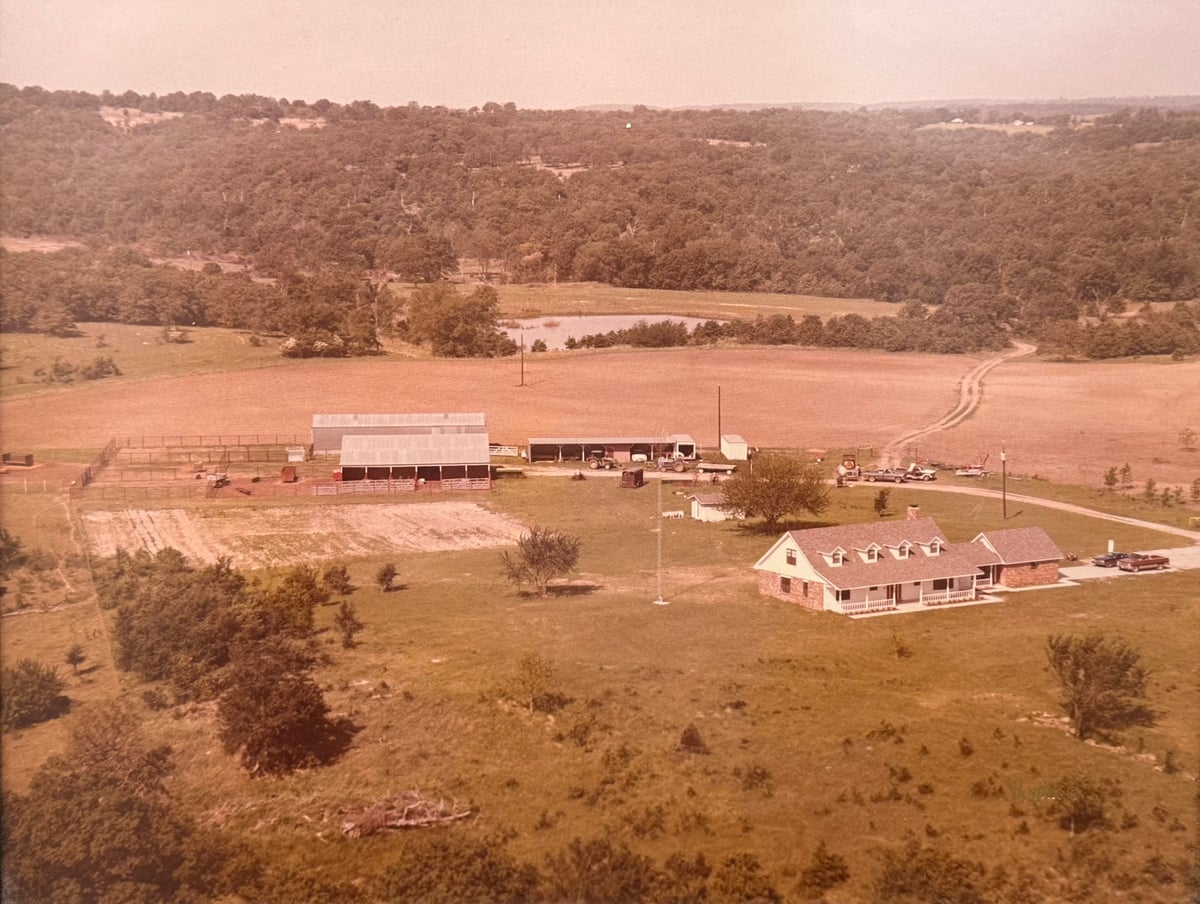
My dad is a painter and contractor. Long retired now, but in his working years he owned his own crew. He built the house I grew up in on a thousand acres in Holdenville, Oklahoma. Drafted the blueprint himself. Did almost everything with his own hands, his crew assisting where needed. From the design on paper to the last coat of paint, a lifetime of trade knowledge applied to the most personal structure a person can create.
He built it because my mom wanted to go home. She wanted to return to her roots, to the place where she grew up, and they both believed it would be the best environment for me to grow up in. The blueprint existed because of her vision. The house existed because of his hands. The whole thing was an act of provision disguised as construction.
He never read a book about the craftsman mindset. He didn’t need one. The craft was the provision. You got good with your hands because your family needed a roof. You built it right because cutting corners meant your kids lived under something that wouldn’t hold. The satisfaction didn’t come first. The skill came first. The pride came from knowing the joints were true and the walls were plumb and the work would outlast you.
He’s 92 now. I still go to him with the hard questions. About work. About fatherhood. About what to do when the ground shifts and the plan you had stops being the plan that works. He’s what made me the father, husband, and man I am today, along with some serious polishing by my wife. Every principle I operate from, I can trace back to that house and the man who built it.
I never realized, until very recently, how much of him is in everything I write.
The craftsman mindset didn’t start in a Georgetown office. It started with paint on calloused hands and a house that still stands.
A friend of mine, Justin Snyder, recently published a piece on Cal Newport’s So Good They Can’t Ignore You as part of a year-long leadership series he’s building. His article struck a chord with me, not because I disagreed with it, but because it named something I’ve been living without having the vocabulary for it.
Newport’s thesis is clean. Follow your passion is bad advice. The better path is to develop rare and valuable skills, accumulate what he calls career capital, and let the satisfaction follow from the mastery. He calls this the craftsman mindset, and he positions it against the passion mindset, which asks what the world can offer you instead of what you can offer the world. The passion mindset produces career-hopping and perpetual dissatisfaction. The craftsman mindset produces, over years, the rare professional who has actually built something that works.
Justin frames it well. He draws attention to the leader anti-pattern that Newport’s work exposes: the boss who demands passion as an input, who confuses expressed enthusiasm with engaged commitment, who recruits for energy instead of skill. That observation is sharp and correct. The leader who optimizes for enthusiasm gets people who are good at performing enthusiasm. The leader who optimizes for craft gets people who quietly outperform everyone over the long run.
I agree with most of this. The craftsman mindset has been my operating position in every role I’ve ever held. Newport’s sequencing is sound. Career capital before control. Control before mission. The order matters, and most career advice gets it exactly backwards.
But I don’t believe following your passion is bad advice. Not at all.
I love technology. So much that I can’t stop doing it. I made it my career and then brought it home with me. My office is full of computers and electronics and gadgets. Our home network is absurdly over-designed. It drives my wife crazy most of the time. This isn’t something that emerged as a byproduct of getting good at my job. It’s intrinsic. The passion was there before the mastery. The mastery gave it productive expression.
Newport critiques the passion mindset, the self-centered version that asks what the world owes you, that treats every job as provisional until the dream role appears, that evaluates work by whether it delivers fulfillment in the present moment. That critique is correct. But he overcorrects. He extends the critique of passion-as-career-strategy to passion itself, and that’s where he loses me. The problem was never the passion. The problem was passion aimed inward instead of outward. Passion that asks what the world can give you versus passion that drives you to build something the world needs.
My dad was passionate about building. His hands wanted to work. But that passion was directed by purpose: his wife’s vision, his family’s need, the house that would shelter his son. The passion was the engine. The purpose was the steering. The craftsman discipline was the transmission that converted both into something that would stand for decades.
Newport’s model works without passion, but it works mechanically, and he acknowledges the risk of it drifting into joyless careerism if misread. His critique of the passion mindset is correct when passion has no purpose behind it. But strip the passion out entirely and you lose the thing that makes the craftsman care whether the wall is plumb. You need both. The craft is what connects them.
That’s where I part with Newport and where my experience picks up. I’ve lived long enough inside this framework to know where it breaks. Not where it’s wrong. Where it’s incomplete. And the gap Newport leaves is where I’ve spent most of my career standing, sometimes by choice, sometimes because the floor gave out.
Newport wrote the theory. The practice has teeth he never accounted for.
I opened the What Architects Actually Do series with a line I’ve been carrying since college: I was supposed to be a doctor. The fuller version is more specific. I wanted to be a cardiac surgeon. I wanted to hold a human heart in my hands and fix it. The impulse was specific: walk into a room where something is broken, diagnose what’s wrong, and leave it better than I found it. I had the interest and the trajectory. Then I realized the path required sacrificing everything outside of it, and I made a different choice.
But the impulse didn’t die when the career path did. It transferred.
The doctor parallel isn’t a metaphor I reach for. It’s the through-line of my career. Diagnose the system. Translate between the complexity of the problem and the reality of the people living inside it. Leave the room better. That’s architecture. That’s also surgery. The medium changed. The impulse didn’t.
Newport would say this validates his model. I didn’t follow my passion into medicine. I landed in a different field and built rare and valuable skills. The craftsman mindset produced the career.
But Newport would also say the passion came after, as a byproduct of mastery. That’s where he’s wrong about my story. The passion didn’t emerge from competence. It transferred. The impulse to diagnose, to fix, to serve, that was always there. It followed me out of medicine and into technology because it was never about the domain. It was about the work itself. The passion found a new medium. It didn’t wait for mastery to arrive before showing up.
What mastery changed was the fear.
I didn’t rationally choose the craftsman path. I didn’t sit down and decide to develop rare and valuable skills in technology because it was the strategically optimal move. I landed in tech because I needed a job. I got good at it because early in my career, a backup failure during a storage migration nearly ended everything. New wife. New child. Forty-eight hours without sleep, alone in a server room, fixing what I’d broken while my internal dialogue screamed that my career was already over.
Fear was the bootloader. Not rational mastery-seeking. Not craftsman discipline. Fear of losing the ability to provide for the people who depended on me. My dad’s principle, operating underneath everything: the craft serves the family. You don’t get good at it because mastery is fulfilling. You get good at it because your kids need you to be.
The passion was always present. But in the early years, fear ran louder. Fear drove the skill accumulation. Family drove the persistence. Competence eventually turned the volume down on the fear and turned it up on the passion that had been there all along. The craftsman mindset was the operating system, but it didn’t boot from the place Newport describes. It booted from Holdenville. From watching a man build a house because his family needed one.
The passion didn’t follow the mastery. The mastery quieted the fear enough for me to hear the passion that was already there.
There was a season in my career where every part of Newport’s model aligned.
I was supporting a children’s hospital. The technology I managed had a direct line to the mission: keeping systems running that helped save the lives of children. The craft was exercised at its actual level. The feedback was honest. The career capital was accumulating. And the mission was so viscerally real that the work carried a weight and a pride I haven’t felt in anything since.
That was the career Newport says the craftsman mindset produces. Rare and valuable skills deployed in service of something that matters, with enough autonomy to do the work well. Career capital, control, and mission, all converging in one role.
And I left.
Not because the passion died. Not because the mission stopped mattering. Because there was a capital ceiling. The environment was honest, the mission was real, but the room to grow was finite. I could see the limit of what my skills could become in that context, and the craftsman mindset told me to leave the place that felt most right in order to keep building.
I went to a place that saw my accomplishments and offered to let me spend more. The reputation I’d built, the work I’d done, the career capital I’d accumulated. They recognized it and promised room to deploy it.
That’s Newport’s model working. Spend career capital on control and growth. Don’t stay where it feels good if staying means the craft stagnates. Make the hard decision. Trust the framework.
Here’s what Newport doesn’t write about: what happens when the place that promises more room delivers something else entirely.
Leaving the place where the craft and the mission aligned was the hardest professional decision I’ve ever made. The craftsman mindset demanded it. What came after revealed what the framework leaves out.
Newport’s career capital theory assumes an honest exchange. You build rare and valuable skills. You trade them for control, autonomy, meaningful work. The market honors what you bring.
It doesn’t always.
I’ve written about this in detail. The consulting environment where I helped build assessment machinery designed to tell enterprise clients the truth about their infrastructure, where I used the word “unicorn” to describe best-case financials during a customer walkthrough and was told to never say that word again. Not because the assessment was wrong. Because the assessment being right threatened the engagement. The partner needs the deal. The practice needs the utilization. The firm needs the revenue. The architect who tells hard truths threatens all of it.
That’s not a passion problem. That’s not a mastery deficit. That’s career capital being actively suppressed because the market it operates in penalizes the very skill that makes it rare. I was doing exactly what Newport prescribes. Building rare and valuable skills. Translating between technical reality and organizational understanding. Becoming, by any reasonable measure, so good they couldn’t ignore me.
The organizational response was to tell me to stop being that good in public.
Newport’s model has a blind spot here that’s dangerous if left unnamed. He treats career capital as though it’s a single category with a stable exchange rate. But there’s a difference between career capital that the market wants to buy and career capital that the market needs but can’t tolerate. Translation, the ability to name what’s actually happening inside an organization, falls into the second category far more often than anyone in the career-advice business wants to admit.
I described the cost of that in a piece about what it’s like to be wired for detection in environments that punish it. The meeting invites that stop appearing. The peers who route around you. The architecture decisions made without you after the fact. Small subtractions, each individually explainable, none of them accidental.
The craftsman mindset says become so good they can’t ignore you. My career has revealed the corollary Newport never addresses: sometimes becoming that good is exactly what makes them decide you have to go.
Career capital is real. The exchange rate is not always honest. And some forms of mastery make you more threatening, not more valuable, to the organizations that need you most.
But the most dangerous blind spot isn’t the corrupt exchange. It’s the complacency trap.
This is the thing I wish someone had written for me ten years ago. And it’s the thing Newport’s framework makes harder to see, not easier.
The craftsman mindset says stay in the discomfort. The discomfort of getting better at hard things is the price of admission. Don’t evaluate your work by how it feels. Evaluate it by what you’re building. The satisfaction comes later, from the mastery, not from the moment.
That’s correct when the discomfort is growth. When the environment is demanding your best work and the friction is the friction of developing new capability.
It’s catastrophically wrong when the discomfort is erosion.
I spent years in an environment where I was wearing hats that weren’t mine. Doing work that wasn’t my craft. Being deployed on problems that didn’t exercise the skills that make me valuable. And the craftsman mindset, the very framework that was supposed to protect against career drift, provided the justification for staying. It’s supposed to be hard. The satisfaction comes later. Don’t chase comfort. Trust the process.
But the process requires an environment that demands the craft. Without that demand, the craftsman degrades. You’re still showing up. You’re still producing. You’re still being told it’s working. But the environment has quietly lowered the bar until what you’re building isn’t your best work anymore. Mass-produced furniture in a shop that calls it artisan because nobody in the room even understands what artisan looks like.
My dad would recognize that distinction in a heartbeat. A painter knows the difference between a wall done right and a wall done fast. A contractor knows when the client is asking for quality and when they’re asking for the appearance of quality. The joints tell the truth even when the bid paperwork doesn’t.
The complacency trap weaponizes Newport’s own framework against the craftsman. You think you’re in the hard middle of the mastery curve. You’re actually being slowly reduced. And because Newport says not to evaluate work by how it feels, you ignore the signal that something is wrong. The dissatisfaction isn’t the discomfort of growth. It’s your craft telling you the environment is lying about what it values.
I stayed too long. That was my miscalculation. I bet on the environment being able to change, on the other half of the equation eventually recognizing and investing in the capital I was offering. I kept applying my dad’s principle, the one that said don’t be reckless with the vehicle that feeds your family. And that principle, which was right for most of my career, kept me in a place where the craft was eroding while the paycheck continued.
My dad would tell me to get back to work and make the organization satisfied. Don’t lose that job. And his advice carries weight because it comes from a man who built a house with his hands for his family. He’s not speaking from theory. He’s speaking from a world where the employer and the employee had a reciprocal obligation. You give your best, they take care of you. That contract held for his generation.
It doesn’t hold anymore. Corporations answer to boards and shareholders, not to the people whose craft built what the board is selling. The principle my dad gave me, that the craft exists to protect your family, is still right. But “make the org satisfied” is no longer the same as “protect your family.” Not when the org will consume your flexibility, assign you work that isn’t your craft, call it growth, and discard the relationship when the board decides to restructure.
The craftsman mindset, applied to “master whatever the organization puts in front of you,” isn’t craftsmanship. It’s compliance wearing the craftsman’s clothes.
The hardest thing to see from inside the complacency trap is that the discomfort you’re enduring isn’t building mastery. It’s building someone else’s furniture with your tools.
I wrote in the Canary piece that I didn’t know whether the canary is the most important thing in the mine or the first thing that dies.
I have an update.
The canary is the thing that remembers what clean air smells like the moment it’s out.
For the first time in over twenty years, I don’t have an employer. The mine is behind me. And the thing I expected to feel, the disruption and the freefall, it isn’t here.
What’s here instead is something I didn’t anticipate. I feel more alive and more free than I have in years. Not because the work is over. Because the work is finally mine again.
The open market is providing the honest feedback the last environment couldn’t. People responding to my actual body of work. My actual career capital. The skills I built across hundreds of organizations and decades of practice. The craft that I carried out the door because it was never theirs to keep.
I wasn’t useless. I was being used for things that weren’t my craft. And the sustained misapplication of what I’d built started to feel like the capital itself had diminished. It hadn’t. The environment was lying about what it valued. I just couldn’t see it clearly from inside the mine.
The career capital was always mine. I was spending it in a market that wouldn’t honor it.
My dad never needed a book to know any of this. His hands told him the difference between a wall built right and a wall built fast, and the house he built for his family told him what the craft was for. The satisfaction came from the work being true, not from someone telling him it was good enough.
Newport wrote the book. My dad built the house.
The principle is the same. The world it operates in changed. And the craftsman mindset, the real one, the one that lives in your hands and not in a framework, demands that you know the difference between an environment that’s making you better and an environment that’s making you less. Between discomfort that builds and discomfort that erodes. Between a place that sees what you bring and a place that’s lying about what it values.
I know the difference now. I learned it the expensive way. Possibly the only way. And I’m standing on the other side of it excited about what lies ahead.
My dad built his house on a thousand acres. Drafted the blueprint himself. Did the work with his own hands. His family needed a home, and he had the skills to build one.
For me, this is now the best part. And if my dad could read this, I know what he’d say.
I’m sitting here realizing that I’m just like him, except I architect and implement technology. I build tech. Different medium. Same hands.
I always wanted to be like my dad. I never thought I was until tonight, 12:10am, as I write this. Sitting unemployed and more grateful and joyful than ever.
Photo by Me. The house my dad built.