Into The AI Governance Trap: The Beaten Path

We’re in the middle of a conversation at work that feels familiar. Leadership wants “AI governance.” Engineering wants “AI guardrails.” Security wants “AI controls.” Everyone’s using different words for the same thing: someone needs to make sense of the chaos before it becomes load-bearing.
I’ve watched this movie before. Cloud governance. Platform governance. Data governance. Security governance. The script is always the same. The ending is predictable.
I’ve written about organizational dysfunction from multiple angles. Why architects stop translating even when they see problems. How technical gluttony accumulates when nobody’s making strategic decisions upstream. Why organizations perform structure without wanting it. The patterns that make platforms erode and governance fail.
AI governance is where all those patterns converge. This isn’t a new problem. It’s the same organizational dysfunction you’ve been living with, now accelerated by AI adoption.
This series connects those dots. Part 1 shows you the map - the nine predictable stages of governance failure and where your organization probably is right now. Part 2 shows you the way out - the preconditions that have to exist before any governance framework can work.
Here’s the map. Here’s where most organizations are right now. And here’s what happens next if you don’t change course.
The industry wants you to believe AI governance is a process problem. Better policies, clearer standards, stronger frameworks. It’s not. It’s an organizational maturity problem disguised as a documentation gap. Every stage you’re about to read through represents organizations choosing theater over function, artifacts over accountability.
The Nine Stages of Governance Failure
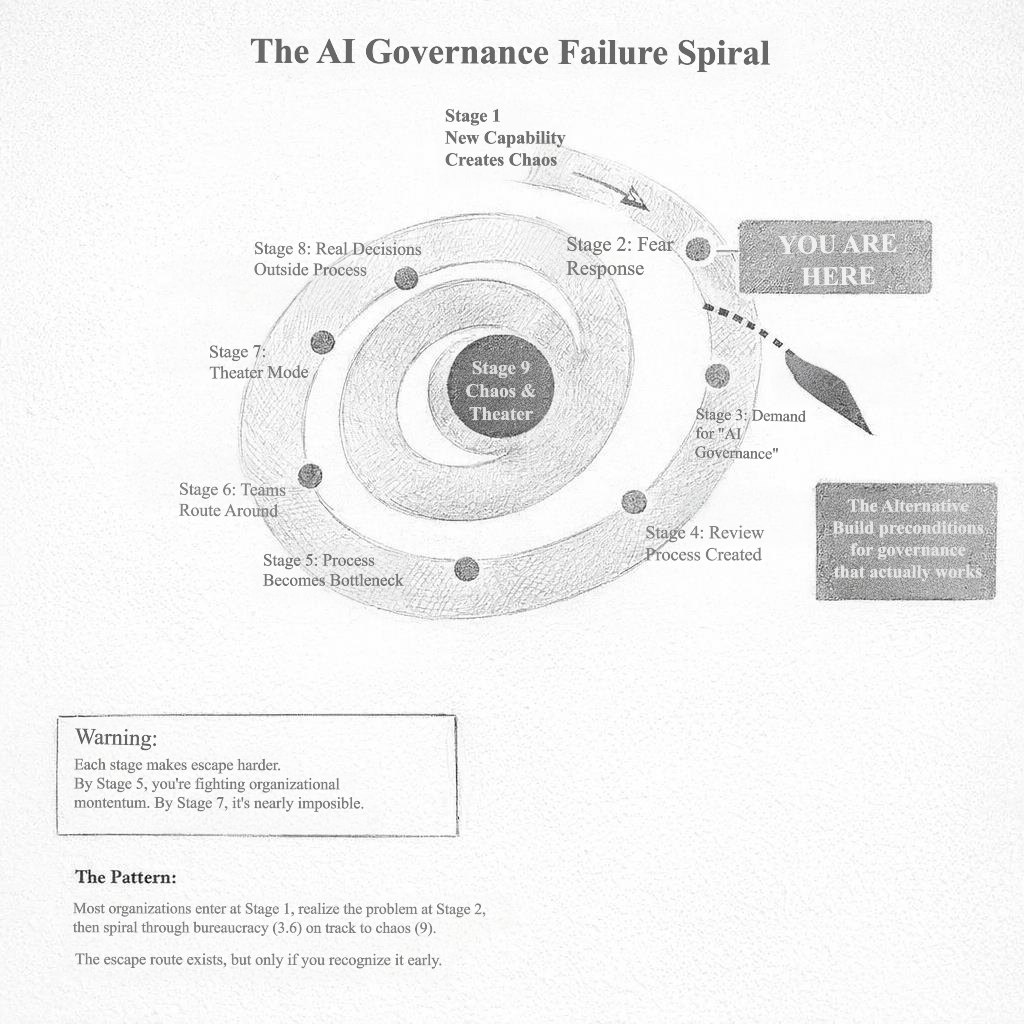
Stage 1: New Capability Creates Chaos
Teams are experimenting. Everyone’s using different AI tools. Some are building with OpenAI. Others with Claude. A few are running local models. Nobody knows what anyone else is doing.
In my own organization right now, the only real standard is VSCode as the base IDE and a choice between GitHub Copilot for Azure teams or Kiro for everyone else. That’s the extent of coherence. On my own team alone, we’re using NotebookLM, Copilot, Claude, Gemini, and now adding ChatGPT. Five tools, one team. Multiply that across the organization and you have AI sprawl that nobody’s tracking.
And it gets worse. Microsoft’s decision to give AI agents human-like identities in your organization - actual accounts in your directory - means you’re not just accumulating tools. You’re accumulating synthetic employees with access patterns nobody designed and nobody’s monitoring.
It looks like innovation. It feels like teams free to explore. But this is technical gluttony in its purest form: distributed “yes” decisions with no strategic filtering, no visibility into the accumulated weight, and no mechanism to even count what you’ve said yes to.
Stage 2: Chaos Creates Fear in Leadership
Most organizations are here right now.
A board member asks about AI risk. A security incident makes headlines. A vendor pitches “AI governance” as the solution. Leadership suddenly realizes they have no visibility into what’s happening.
The chaos was invisible until someone with authority asked a question nobody could answer. Now it’s a problem that demands a response. Leadership tells themselves they need to get control of this before it becomes a bigger problem. But the problem already exists. They’re just noticing it now.
Most organizations are somewhere between Stage 2 and Stage 3. Leadership knows there’s chaos. They’re starting to demand answers. The “AI governance” conversation has started. Someone’s been tasked with “figuring this out.”
If this describes your organization, you have a choice to make. If you want to follow the same script everyone else follows, keep reading - I’m going to tell you exactly what happens next. If you want something different, stop here and wait for Part 2.
The window for choosing is narrow. Once you hit Stage 3, organizational momentum takes over.
Stage 3: Fear Demands “Governance”
Someone gets tasked with “standing up AI governance.” Could be security. Could be architecture. Could be a new role created specifically for this. They start writing policies, creating review processes, building frameworks.
Organizations default to structure when facing uncertainty. If you can’t control the technology, control the process around the technology. Leadership thinks that if they document the standards and create review checkpoints, they’ll have governance. But they’re building artifacts, not governance. The documents won’t change behavior unless they’re backed by authority and accountability.
This happens identically across cloud governance, platform governance, and data governance. Someone creates a beautifully documented framework with comprehensive policies and clear standards. Then they present it to leadership, who nods approvingly and asks “when can we start using AI safely?”
The framework doesn’t answer that question. Because the framework isn’t governance. It’s the artifact that makes governance look like it exists.
Stage 4: Governance Gets Implemented as Review Process
The policies exist. Now someone has to enforce them. So governance becomes a checkpoint: a new form required before using AI, architecture review board approval, security sign-off on data handling. And now legal is involved - because nobody “trusts” AI, even though the reason legal is involved at all is because AI sprawl has already become a wildfire of chaos running through the organization.
Every AI initiative has a checklist. The checklist exists because leadership can point to it and say “we have governance.” They can measure compliance. They can report progress.
Review processes are concrete. They’re measurable. Leadership can point to them and say “we have governance.” They think that now that they have a process, the chaos will stop. But they’ve created a traffic cop, not an enabler. Teams will either comply minimally or find ways around it.
This is where most governance attempts position themselves wrong from the start. The governance function becomes a checkpoint. Submit your proposal, wait for approval, get a yes or no.
The problem isn’t that review processes are inherently bad. The problem is positioning. When governance shows up as a traffic cop, teams treat it as an obstacle. When it shows up as an enabler embedded in the design phase, teams treat it as a partner.
Most organizations discover this positioning problem after they’ve already implemented the stop lights. By then, the first impression is set. The governance body is the group that says “no” and makes things take longer.
Stage 5: Review Process Becomes Bottleneck
The review board meets monthly. AI initiatives pile up waiting for approval. Teams complain the process takes too long. Business units escalate because their projects are blocked.
Review capacity doesn’t scale with demand. The governance function is positioned as a checkpoint that must be passed rather than a partner that enables success. Leadership thinks they just need more people on the review board. But adding capacity to a poorly positioned function doesn’t fix the positioning problem.
One organization stood up a cloud governance board. They started with quarterly reviews. Demand quickly outpaced capacity, so they moved to monthly. Then bi-weekly. Then they added more reviewers.
At peak, they had eight people on the governance board spending 20% of their time reviewing proposals. The backlog still grew. Teams still complained about delays. Business units still escalated.
The organization treated this as a capacity problem. It was a design problem. The governance model was fundamentally broken. More reviewers just meant more people participating in a broken process.
Stage 6: Teams Route Around Bottleneck
Shadow AI appears. Teams stop asking permission. They use personal accounts. They call it “prototyping” to avoid review. They build first, seek approval later, if at all.
Business pressure beats governance theater. When the official path is slow and the unofficial path is fast, people choose fast. Leadership thinks they need stronger enforcement and better tracking. But the governance model is fundamentally broken. Enforcement theater won’t fix it.
This is where organizations discover that you can’t actually enforce governance through policy alone. You need one of two things: either real authority backed by consequences, or positioning that makes following governance easier than avoiding it.
Most organizations have neither real authority nor enablement positioning. The governance body can’t help teams succeed faster because they were never set up to do that. They can only document objections. When business units escalate, leadership sides with “get it done” because governance was never positioned as the thing that helps you get it done.
So teams learn. The smart ones figure out how to stay under the radar. Call it a prototype. Use a personal account. Get it working first, then show governance something already in production. Much easier to get approval for something that’s already demonstrating value.
The governance body knows this is happening. They’re meaningless in the process.
There’s a moment in Stage 6 that determines everything. The governance body discovers a team shipped an AI implementation without review. They have a choice: escalate and force a confrontation, or document the exception and move on. Most choose documentation. That choice teaches the organization that governance is optional. Once that lesson is learned, you’re in Stage 7 whether you admit it or not.
Stage 7: Governance Becomes Theater
The review process still exists. People still submit forms. The board still meets. But everyone knows the real decisions happen outside the process. Governance documents what’s already been decided.
Here’s what the capitulation looks like from the inside. I’ve been hired into this role. An organization brings you in with the title and the mandate, then makes clear your actual job is to sit in the corner, agree with everything, and document. No teeth. No authority to force uncomfortable conversations. No expectation that you’ll challenge decisions already made.
You’re not governance. You’re the artifact that proves governance exists on paper. The organization doesn’t want what you can do. They want what your presence represents. The moment you realize this is the moment governance died - probably before you arrived.
When organizations deliberately hire for capitulation, they’re not failing at governance. They’re succeeding at theater. The role exists to absorb accountability without having authority. That’s not an accident. That’s the design.
Organizations learn to perform structure without wanting it. The governance function becomes about liability management, not actual partnership and enablement. Leadership tells themselves that at least they have documentation showing they tried. But they’re paying for a function that provides no value beyond CYA.
The difference between performing structure and wanting it shows up everywhere. This is the terminal stage of perform mode. The governance body still exists. They still produce artifacts. But nobody’s pretending it matters anymore.
The tells are everywhere. Review meetings where nobody asks hard questions. Proposals that get approved because rejection would require explaining why. Standards that exist on paper but nobody follows in practice. Documentation that gets produced for audit trails but never referenced for actual decisions.
The governance body might not even realize they’re in theater mode. They’re still busy. Still producing deliverables. Still meeting regularly. The activity feels like progress. But strip away the artifacts and ask: what has the governance body actually helped to enable and innovate? What would be different if the governance body didn’t exist?
Usually, the honest answer is “nothing.”
Stage 8: Real Decisions Happen Outside Governance
Architects work directly with teams. Security negotiates case-by-case. Business units make technology decisions based on vendor relationships. The governance body is informed after the fact, if at all.
When official governance doesn’t work, informal governance fills the gap. The people who actually need to make things happen find ways to do it. Leadership still thinks the governance body has authority. But authority without respect is just paperwork.
This is where the governance body becomes an afterthought. The organization has learned to route around them so effectively that even keeping them informed feels optional.
The real decisions happen in hallway conversations. In direct messages between architects and team leads. In vendor negotiations where business units commit to platforms before governance knows they’re being evaluated. In escalations to executives who approve projects before the governance body has a chance to provide the illusion of choice.
The governance body finds out when someone remembers to cc them on an email. Or when a new AI deployment shows up in the security scan. Or when a team mentions in passing that they’ve been running an AI workload in production for three months.
Everyone’s polite about it. Nobody says “we’re ignoring governance.” They just work around it. Naturally. Because that’s what happens when official channels don’t work.
Stage 9: The Chaos Continues (Now With Extra Meetings)
Tool sprawl continues. Teams still operate independently. AI implementations still vary wildly. But now you also have governance overhead, documentation requirements, and review processes that don’t accomplish anything.
You added structure without addressing the organizational dysfunction that caused the chaos in the first place. Leadership tells themselves that at least they’re doing something. But they’ve made the problem more expensive without making it better.
This is the final stage. You’re back where you started with chaos, no coherence, and teams doing their own thing. Except now you’re also paying for a governance function, producing documentation nobody reads, and spending time in review meetings that don’t remove blockers or advance organizational vision.
The cost is real. The governance body is staffed by people who could be doing other work. The review process consumes team time. The documentation requirements add overhead to every project. The meetings fill calendars.
And the chaos you were trying to prevent? Still happening. Just with more paperwork.
Most governance experts will tell you the solution is better frameworks, clearer policies, stronger enforcement. They’re wrong. The solution is admitting you’re solving the wrong problem.
Where This Ends
Most organizations will cycle through stages 3-9 repeatedly. Each cycle adds more process and overhead. The chaos never actually resolves. And worse yet, your best architects will either stop translating or leave.
A few organizations will recognize the pattern early and choose a different path. They’ll build the preconditions required for governance to actually work. They’ll position governance as enablement rather than enforcement. They’ll vest it with actual authority and actual accountability.
Those organizations won’t just have better AI governance. They’ll have better everything. Because the preconditions that make governance work are the same preconditions that make any operational paradigm work.
The question isn’t whether your organization is on this map. You are.
The question is whether you’ll recognize where you are in time to change course, and whether you’re willing to do the work that makes the difference.
In 18 months, organizations at Stage 9 will have AI implementations they can’t inventory, data flows they can’t trace, and governance documentation that describes a world that doesn’t exist. They’ll have spent real money on review processes that review nothing.
And when the incident happens, they’ll discover that theater doesn’t protect you from consequences. Ask the acting director of the Cybersecurity and Infrastructure Security Agency who uploaded sensitive documents marked “for official use only” into the public version of ChatGPT. The person responsible for national cybersecurity guidance made exactly the mistake that governance theater fails to prevent.
That’s where the spiral ends. Not with malice. With normalization. The chaos becomes background noise. The theater becomes routine. And then someone with access to sensitive information does exactly what the environment trained them to do.
The question isn’t whether to follow the script. The question is whether you can afford where it ends.
What Happens Next
Next in Series: Escaping the AI Governance Spiral: The Road Less Traveled →
The path into the spiral looks faster. It produces visible artifacts. It lets you check boxes and tell leadership “we have governance.” That’s why everyone takes it. The hard path requires conversations leadership would rather avoid, authority that threatens existing power structures, and measurement that might reveal uncomfortable truths. But the spiral always ends the same way: chaos plus theater. Make a decision.
If you can’t wait for Part 2 and want to understand the foundational organizational health requirements that make governance possible, start with Decide or Drown Part 4. For more on why governance becomes theater, see The Two Tells. For understanding why architects stop doing the translation work that governance requires, read Architects Stop Translating.